
Ajanta Radiators / Newsroom

Latest Global Cooling News

Industry intelligence on radiators, heat exchangers, thermal management and next-generation cooling.

Global Cooling Industry News October 2026 – Ajanta Radiators Global Cooling Industry News – 17 October 2026 | Ajanta Radiators 17 October 2026 Explore this week's global cooling industry developments, including Vertiv's 30 MW liquid cooling project in Mumbai, Valeo's aluminium heat exchanger technology and AKG's latest manufacturing…
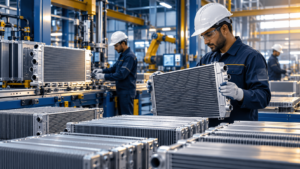
Aluminium radiator and heat exchanger manufacturing technology with industrial cooling equipment Global Engine Cooling News – 9 October 2026 09 October 2026 Global cooling technology is advancing rapidly as Valeo introduces high-performance aluminium heat exchangers for data centres and AKG expands industrial brazing capabilities. Explore the latest…
AR
AJANTA RADIATORS NEWSROOM Global Cooling & Thermal Management
← Ajanta Radiators
WEEKLY EDITION · 05 OCTOBER 2026 · GLOBAL

Cooling Moves to 800 Volts DC.

Trane Technologies, Eaton and Danfoss have demonstrated a new direct-current chiller architecture delivering more than 3.5 MW of cooling — another signal that thermal management is becoming part of the power architecture itself.

Today's Lead Source: Trane Technologies 30 September 2026
800 VDC Direct-current input demonstrated on the chiller platform
3.5+ MW Cooling capacity demonstrated in laboratory testing
1,000+ Tons of cooling capacity reported by Trane
THERMAL MANAGEMENT · DATA CENTRES

The electrical system and cooling system are beginning to merge.

One of the most significant cooling developments of the past week did not involve a larger radiator or simply a more powerful fan. It involved changing the electricity supplied to the cooling plant itself.

Trane Technologies announced that it had successfully demonstrated an 800-volt direct-current cooling architecture designed for next-generation AI factories and large-scale data centres.

Working with Eaton and Danfoss, Trane modified an existing high-efficiency chiller to operate directly from an 800 VDC supply. According to the company, the laboratory proof of concept delivered more than 1,000 tons — over 3.5 MW — of cooling capacity.

Why direct current matters

Conventional cooling equipment typically receives alternating-current power. Compressors, pumps and other electrically driven components can require power-conversion stages before that electricity reaches the form required by the equipment.

Trane says supplying the system directly with 800 VDC can reduce some of those conversion losses. During the demonstration, the company reported potential system efficiency improvement of up to 2 percent compared with conventional AC-powered counterparts.

The engineering signal

Cooling is no longer being treated only as equipment attached to a heat source. In high-power applications, designers are increasingly considering electrical architecture, coolant distribution, heat exchangers, pumps, controls and heat rejection as one integrated thermal system.

Small percentages become large numbers

A two-percent improvement may appear modest when viewed at the level of one machine. At hyperscale infrastructure levels, however, even small reductions in auxiliary energy consumption can represent substantial available power.

Trane estimates that the demonstrated efficiency gain could potentially release up to 1.8 MW of additional computing capacity in a typical 200 MW data-centre installation.

The broader significance for the cooling industry is not the specific data-centre application alone. It is the direction of engineering: as thermal loads increase, cooling systems are being designed increasingly around total system efficiency rather than around an isolated heat exchanger.

A familiar principle at a much larger scale

Industrial radiator engineering follows the same basic physical objective: absorb heat from a working fluid, carry that heat efficiently through the exchanger and reject it into the surrounding environment.

Whether the equipment is a diesel generator, construction machine, commercial vehicle or high-density computing facility, effective cooling still depends on balancing thermal load, coolant flow, airflow, heat-transfer area, pressure drop and ambient operating conditions.

Three more signals this week.

Developments selected because they indicate where radiator, heat-exchanger and thermal-management engineering is heading.

CASTROL · GLOBAL 29 SEP

Castrol moves from cooling fluids toward complete thermal-management systems

Castrol has launched Castrol CORE, an integrated data-centre thermal-management offering spanning cooling technology, system design, testing, deployment and lifecycle support. The move reflects a wider industry shift from selling individual cooling products toward engineering complete thermal systems.

Original source ↗
MOBILE MACHINERY 28 SEP

Radiator sizing starts with heat rejection — not horsepower alone

A new engineering note from Calatherm highlights engine heat rejection as the fundamental starting point for sizing cooling systems in mobile machinery. Thermal load must be considered across coolant, charge air, lubricating oil and other heat sources before the cooling package can be correctly selected.

Original source ↗
HELLA · GERMANY 08 SEP

Engine cooling becomes a bigger aftermarket category

FORVIA HELLA says its thermal-management aftermarket range has expanded beyond 3,600 part numbers, including significant additions for engine cooling. Its stated target is more than 6,000 references by spring 2027, illustrating how cooling components are becoming a larger specialised aftermarket segment.

Original source ↗
AJANTA
NEWSROOM
ANALYSIS

The radiator is increasingly one part of a complete thermal-management architecture.

This week's developments span very different industries, but the engineering direction is remarkably similar. Cooling requirements are increasingly being defined by the total heat that must be rejected, where that heat originates, how it is transported and how much energy is consumed while removing it.

For conventional diesel and heavy-equipment cooling, this reinforces an old but important engineering rule: radiator dimensions alone do not define cooling performance. Core construction, coolant flow, airflow, fan characteristics, auxiliary coolers, ambient temperature and the engine's actual heat-rejection requirement all matter.

Three lessons for industrial cooling.

01

Design from thermal load

The correct starting point is the amount of heat that must be rejected under the actual operating condition, not simply engine rating or physical radiator size.

02

Cooling is a system

Radiators increasingly operate alongside charge-air, oil, hydraulic, battery and other heat exchangers. Airflow and pressure-drop interaction between these components can affect the whole cooling package.

03

Ambient temperature matters

A heat exchanger that performs correctly in moderate conditions may have significantly less thermal margin at high ambient temperatures or under continuous maximum load.

Earlier edition.

23 September 2026

Engine Cooling Moves Inside the Exhaust Valve

Eaton's Turbulator enhanced-cooling hollow exhaust valve uses improved internal sodium circulation to move heat away from one of the hottest components inside a heavy-duty combustion engine.

Eaton source ↗
TOPICS IN THIS EDITION Thermal Management Industrial Cooling Engine Cooling Radiator Engineering Heat Rejection Heat Exchangers Data Centre Cooling Heavy Equipment
Learning Centre

How Industrial Radiators Work

Understand coolant flow, radiator cores, airflow and the basic heat-transfer process used in industrial engine cooling.

Read technical guide →
Power Generation

DG Set Radiator Engineering & Service

Technical information on generator radiators, repair, recoring, new manufacture and cooling-system requirements for industrial diesel generator sets.

Explore DG set cooling →

Ajanta Radiators Global Newsroom: independent global cooling-industry coverage focused on radiators, heat exchangers, engines, heavy equipment and thermal-management technology. External company performance statements and test results are identified as source claims; Ajanta's interpretation is presented separately. This edition was prepared on 05 October 2026 using source material available at publication time.

AJANTA RADIATORS →